Tuesday, 7 October 2014

Relationship Spotlight: Alice & the Knave of Hearts (Once Upon a Time in Wonderland)

 
Though this short-lived spin-off of Once Upon a Time was quite a bit shakier than its parent show (and in later seasons, that’s saying something,) I grew to enjoy it.  The heavier reliance on CGI and talking animals gives it an inherently hokey quality, and the melding of fictional realms – chiefly Wonderland and Aladdin’s Agrabah – doesn’t feel as organic as it does in the original series.  Still, it has some interesting characters, intriguing ideas, and, best of all, the great relationship between heroine Alice and the contrary but loyal Knave of Hearts.
 
Quick background:  as in the Lewis Carroll stories, Alice travels from Victorian England to the fantastical Wonderland as a child.  When she returns home, however, her father thinks she’s pulling a Lucy Pevensie and is lying, crazy, or both, and she starts spending more and more time in Wonderland searching for proof she can bring back to her father.  The series’ main story begins with Alice as a young woman languishing in a sanatorium, when her old Wonderland buddy the Knave breaks her out.  Cyrus, her True Love back in Wonderland, presumed long dead, is alive and in trouble, and the Knave reluctantly agrees to help Alice rescue him.
 
We’re fairly dropped into the story, as well as into Alice and the Knave’s history together.  We know their paths crossed in the old days, and at some point, Alice recovered his heart for him (in the Once Upon a Time universe, hearts can be removed from their owners and used to control or kill them.)  Usually, she’s not one to hold anything over someone’s head, but the Knave’s cynicism about her True Love mission leads her to remind him how much he owes her.  Even then, she needs to sweeten the pot with some promised palm-greasing.  This gives them an amusing dynamic from the get-go, since Alice is fierce, determined, and earnest, and the Knave is a jaded rogue who just wants to go home.  Their light bickering is a lot of fun.
 
Yet, despite his complaints, the Knave is in it for the long haul.  He remains at Alice’s side as a friend and compatriot, helping whenever he can and offering his input where strategy is concerned.  Like I said, he’s not the believer in True Love that Alice is (once bitten, twice shy,) and he sometimes tries to hint that she should prepare herself for something less than a happily ever after.  It’s not to be a killjoy – he’s worried and wants her to steel herself against getting hurt.  Ultimately, though, he follows her lead regarding Cyrus and doesn’t begrudge her faith.
 
He gets the brunt of the friendship stuff, since it’s Alice’s story and she’s mainly focused on rescuing Cyrus, but she proves herself a true friend to the Knave as well.  To the extent that people other than Cyrus are on her radar, the Knave is on hers; they get to know each other much better over the course of their quest, and she learns more about the circumstances that caused him to lose his heart before they met.  She helps him out of scrapes, generally values his contributions, and encourages him not to give up on the idea of love.
 
It’s a close, significant, utterly platonic connection, and I love it.  They save one another’s lives, aren’t afraid to get in each other’s business, and also know when to give each other some space.  What’s more, the show itself doesn’t play up any sort of jealousy angle, there’s not even a hint of will-they-won’t-they, and it really recognizes the importance of the relationship – during the concluding scenes of the series, a gorgeous Alice-Knave moment takes pride of place.  I need duos like this every now and then, and these two gladly oblige.

Monday, 6 October 2014

Top Five Shorts: Fatty Arbuckle & Buster Keaton

Before he started creating his own shorts, Buster Keaton cut his teeth in cinema with the help of Roscoe “Fatty” Arbuckle (for the uninitiated, a popular silent comedian of the time.)  He began as an apprentice/bit player for Arbuckle and quickly became a partner in front of and behind the camera.  Of their extant collaborations, these are my top picks.

 
Out West (1918) – This rough ‘n’ tumble comic western marks one of Buster’s first major rolse in an Arbuckle movie.  Like many Arbuckle shorts, it’s more of a set piece than a story, mostly an excuse to perform as many Wild West gags as can be crammed into two reels.  Fatty rides the rails to a frontier town, and with the help of sheriff/saloon owner Buster, he saves his girl from an unsavory character in a big, climactic blowout.
 
Best Buster Bit:  When the loutish Wild Bill Hickup first shows up in the saloon, making trouble, Buster’s attempts to oust him are as dogged as they are ineffectual, and it’s wondrously funny.
 
 
The Bell Boy (1918) – This might be my favorite of the lot.  Here, Fatty and Buster run amok as jacks of all trades in a two-bit motel.  There are tons of Buster-ish mechanical gags, including some fantastic stuff with the elevator, and I love the shaving sequence.
 
Best Buster Bit:  In a moment of peril, Buster executes this amazing, almost muay thai move and then launches instantly into a series of proto-parkour tumbling that’s simply stunning to watch.
 
 
The Cook (1918) – Fatty is a short-order cook with a knack for juggling (one who can apparently produce anything from the same pot,) and Buster is a loudmouth waiter who can catch anything on a plate.  The long string of spaghetti gags is particularly noteworthy.
 
Best Buster Bit:  There’s some fabulous dancing that I can hardly believe anyone was doing in 1918.  It’s both delightful and awesome.
 
 
Back Stage (1919) – Buster’s vaudeville background was probably instrumental in the creation of this short, which sees Fatty and Buster as stagehands at a low-rent playhouse.  They get up to enough hijinks behind the scenes, but the real fun starts when the talent backs out and the crew has to put on the show themselves.  
 
Best Buster Bit:  It’s a tie between some impressive acrobatics in a dress and a daring aerial apprehension.  The things he did were just incredible.
 
 
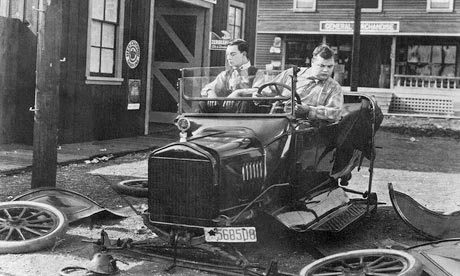
The Garage (1919) – At the garage/firehouse where they live and work, Fatty and Buster cause some havoc, anger some motorists, and get into lots of trouble.  Lots of mechanical gags here, thanks to a massive turntable, spring-action beds, and a collapsing car.  Buster’s shimmying on the firemen’s pole is terrific, and there’s a fun rescue.
 
 
Best Buster Bit:  Everything involving Buster losing his pants.  It sounds cheap/shallow, but it’s hilarious and creative, and I love his seamless coordination with Fatty in the sequence’s last gag.

Sunday, 5 October 2014

Doctor Who: Series 8, Episode 7 – “Kill the Moon” (2014)

 
One of the better offerings of the season.  It has its share of problems – the resolution is a bit of a narrative cheat, the show still doesn’t seem to have much interest in showing the Doctor doing Doctory things, and I’m not sure what to make of where the Doctor-Clara relationship is going – but it’s an interesting story with an intriguing dilemma, and the Doctor is in pretty good form.
 
It’s 2049, and something’s up with the moon.  While on a lunar jaunt, the Doctor, Clara, and a one-shot tagalong (won’t name names, spoilers and all) notice that the moon’s gravity isn’t what it ought to be.  They run into a team of astronauts sent to investigate the moon-related source of some serious problems happening on Earth, and the answer is one that no one expected.  There’s an abandoned space base, some scary critters, and an imaginative alien plot.
 
The best plus is the version of the Doctor we get this week.  It seems he’s been written all over the place this season, and his characterization here pretty well lines up with what I like about him.  He’s observant and intelligent, and he’s both curious and excited about the central mystery.  I love that.  Twelve so often seemd like he can’t be bothered with much of anything, and it’s wonderfully Doctor-ish to see him puzzling over the unexpected and lighting up when he discovers something new.  He has good bite without taking it too far, and here, we see him actually taking a step back to let the humans make their own decision about something crucial.
 
That’s intriguing to me.  It’s unlike the Doctor, and it may be seen as cruel (it is, by some,) like he’s guided them deep into a cave and then told them to find the way back themselves.  It may be callous, again with that alien detachment that we’ve seen more of with this regeneration.  It may be a bit of a mind game that only gives people the illusion of agency.  On the other hand, it may be the Doctor recognizing his rather paternalistic relationship with humanity and realizing he shouldn’t have a right to make decisions for them.  It may be an acknowledgment of his faith in Clara, knowing that she can make a just call.  While it’s very likely that elements of the earlier possibilities are mixed in with the Doctor’s motives, I think he’s ultimately coming at it, or at least trying to, from the right place.
 
I’m of two minds about Clara’s reaction.  I get that, by episode’s end, she’s been through a lot and has good reason to be frustrated and/or upset.  However, there seems to be this disconnect between her and the Doctor, and she can’t see where he’s coming from at all.  The relationship between the Doctor and Clara has always been kind of nebulous, but it’s really floundering this season.  The show doesn’t spend much time showing us what they think about each other, and the little it does show often feels inconsistent.  Here, I’m brought right back to the end of “Deep Breath,” with the Doctor urging Clara to seehim, and it seems like she still can’t.  It’s like there hasn’t been any progress since her post-regeneration doubts and fears, and if so, what’s the point?  What’s the show trying to say?  Can she not get past the fact that he’s changed?  Has he changed so much that he can’t be what she needs anymore?  Are they going to get nudged back on course, have they both drifted too far, or are they going to continue on in this way:  he makes disparaging remarks about her and yet seems desperate for her companionship, and she treats him rather like one of her students while somewhat begrudgingly fitting him into her schedule?  If the story they’re trying to tell is that Clara and the Doctor are no longer a good fit, I wish they’d tell it a bit more quickly, because that sort of distant dysfunction isn’t why I watch Who.

Relationship Spotlight: Patrick & Sam (The Perks of Being a Wallflower)


Curses and damnation, I once again neglected to post.  Have one now and enjoy a second later tonight, after I've made it home from Buster Keaton Land and have had time to catch up on Who.

I was taken with The Perks of Being a Wallflower from the first time I saw the trailer.  The movie didn’t entirely live up to my giddy expectations, since chunks of the plot are a bit rote and meandering, but where characters and relationships are concerned, it delivers 100%.  (Note – I didread the book after seeing the film, but I’m mainly focusing on the more vibrantly-realized characters of the movie.  Luckily, Stephn Chbosky wrote both, so the film versions are just as canon.)  And much as the trailer first indicated, the film’s greatest assets are the spectacular characters Patrick and Sam and the delightful relationship between them.
Sam and Patrick are two people that spring to mind when I think of the term “platonic soul mate.”  Their connection is so innate that, when Charlie initially hangs out with them, he thinks they’re a couple rather than stepsiblings.  Not that there are any creepy vibes going on.  Rather, they’re simply so close and so in sync that it doesn’t occur to Charlie that other types of relationships could be so important.  In every way, they just fit.
Both characters have been through some rough stuff.  They’re both presumably children of divorce, Patrick has a secret boyfriend with a strong streak of internalized homophobia, and Sam has been knocked around six ways to Sunday.  They’re there for one another when they need it, but more than that, they bring such genuine happiness into each other’s lives.  Looking at them when they’re together, you wouldn’t think either is dealing with anything heavy.  Rather, they joke, they do crazy teenage things, and they listen to music like it was written for them.  Everywhere from football games to parties to midnight showings, they have fun with an us-against-the-world flair that’s somehow both determined and happy-go-lucky.
The story does a fine job showing how indispensable teenagers’ interests are to them, that almost spiritual bond that’s forged when they find someone who’s into the same things that they are.  It goes beyond shared pastimes or conversation fodder; it’s a validation that tells them they’re okay, and the more underground the interest, the more significant the bond.  This is an affinity that Patrick and Sam have in spades, with their mutual love of “cool music” (one of the most subjective phrases in the English language) and Rocky Horror.  Even when their present passions don’t wholly align, their tastes are similar enough that they can easily turn one another onto whatever they like.  This is also a big part of what makes Charlie gravitate toward them.  He’s hungry for that bond, and in his pursuit of it, he discovers plenty of new hobbies and life-changing music (music is always life-changing at that age.)
I really love that they’re stepbrother and stepsister.  Such tight, supportive sibling relationships in and of themselves are rare enough – yes, I know you can name any number of counterexamples, but I’m talking about the grand scheme of things here – but I don’t think I’ve ever seen a stepsibling relationship like this.  I’m madly curious to know how old they were when their parents got together, if they already knew each other/were friends before this, and if they were this close from the start or if they had some growing pains.  Alas, though they’re integral to the story, they’re still only supporting characters, and we don’t get details like that.  Regardless, it’s a very different sort of connection.  They’re not lovers, they have no blood ties, and if they met through their parents, they were thrown together rather than choosing one another for friendship.  And yet, their link is unbreakable.  I just adore that.

Friday, 3 October 2014

Favorite Characters: Becca Huffstatter (Huge)

Is it wrong to love a character because they remind you so much of yourself?  I don’t care; this shy, bookish girl resonates with me so entirely.  It’s an acute familiarity, one that pulls me right back to my teenage years.  I wasn’t awkward in the same way – my adolescent awkwardness was a completely different animal – but the feelings, temperament, and sensitivity behind it is wholly the same.  Though “shy, bookish girl” is an admittedly common trope, I’m not sure I’ve ever seen it captured quite so well on TV.
A repeat visitor to weight-loss-centered Camp Victory, Becca is a quiet bundle of insecurities.  To paraphrase a line from Othello, she makes friends not wisely but too well:  the few friendships she manages to forge are extremely cherished, and the loss of one is felt deeply.  She’s incredibly shy but hungry to connect with someone, a difficult one-two punch.  She needs someone like the much-more-outspoken Will to make the first move, to speak in her general direction if not specifically to her.  Then, she can swallow her nervousness enough to timidly dip her toes in the water of friendship.
The resemblance I see in this nervousness, this conversational paralysis, is almost squirmingly uncomfortable.  My heart goes out to Becca when she doesn’t get to watch a certain show because she can’t bear to ask for use of the TV.  So often, she lingers the edge of a scene, waiting for invitations that aren’t forthcoming.  It’s the old feeling that social interactions are like a moving train, and in order to take part, she needs to jump on.
But sometimes, she jumps.  When she wants to start a camp LARPing group (she’s a huge fantasy nerd – I love it,) she sets out to find members, taking along Will for moral support.  She also stands up boldly for her friends, usually Will.  She lays into a pair of self-centered girls who find Will’s private journal in the lost and found, and when Will finds out her crush thinks she’s gay, Becca sets him straight in a hilarious, half-panicky declaration.
She’s not as good at speaking up on her own behalf.  If she can open up to someone, she’ll gently come alive with geeky delight describing the fantasy universe she created for her LARP or the runic cypher she uses when she’s writing something for-her-eyes-only in her journal.  In general, though, she struggles to get her emotional needs met.  She has one of those faces that apparently beg for people to tell her their problems, and she spends a lot of time on the receiving end of other people’s crises, mostly Will’s.  They never seem to get around to Becca’s worries, which build until she simply can’t hold them in any longer.  Then, we get a beautifully messy moment of catharsis where everything she’s bottled up comes tumbling out and Will is forced to be the listening ear for once.  Ah, the sweet taste of introvert victory!
I like that, despite her fears and shyness, Becca still musters up quite a bit of bravery.  Organizing the LARP takes massive guts for someone like Becca, and in one of the show’s most memorable scenes, she acquits herself fantastically just when it looks like she might be caught in a fib.  Her accomplishments in these scenes, for her, are akin to looking down the barrel of a loaded gun, and I only hope I had that much nerve when I was her age.

Thursday, 2 October 2014

Top Five Celebrity Appearances: Extras

Totally forgot to post yesterday, many apologies.  (Up to the gills in Buster - happy place...). To make it up to you, I'll give you two today.

So, here's number one!  I really enjoy Extras, Ricky Gervais and Stephen Merchant’s second big sitcom after The Office.  Like its predecessor, the cringe comedy can sometimes be a bit strong for my tastes, but I like all the characters, the amusing conversations, and the fun look at British film- and television-making.  Without a doubt, however, the most entertaining part is the prominent celebrities playing unflattering versions of themselves.  Here are the best in my book.

Daniel Radcliffe
“I’ve done it, you know. […] With a girl.”  I get such a kick out of macho-posturing Daniel Radcliffe, showing off his cigarettes, trying to score with Maggie, and carrying around his unwrapped “ready for action” condom.  It’s a hilarious parody of child-star train-wrecks, and Radcliffe’s dorky, wannabe-playboy performance is a stitch.


Patrick Stewart
If I’m ever trying to convince someone to give Extrasa shot, I show them the scene of Andy with Patrick Stewart in his dressing room.  Stewart’s screenplay pitch, about an ordinary man who seems to use his superhuman mental powers mainly to see women with their clothes off, is delivered with such pitch-perfect earnestness; it just kills me.  I’m also fond of Stewart puzzling over a grown man with no wife or girlfriend who’s never seen Star Trek.


Orlando Bloom
Goodness gracious, how I love Orlando Bloom’s escalating attempts to “prove” his good looks to Maggie.  Especially good is his deep-seated loathing for/obsession with Johnny Depp and his insistence that the mere thought of kissing Johnny Depp makes Keira Knightley nauseous.  Not only is it wonderfully funny, but it provides a nice win for Maggie in an episode where she really needs one.


Kate Winslet
As an opposite to my last top five, Kate Winslet is the only woman on this list, and now that I think about it, the only female celebrity prominently featured on Extras – weird.  Still, she more than holds her own beside the boys.  Winslet’s calculated Oscar-baiting (Holocaust movie = guaranteed Oscar) is both astute and darkly humorous, and I like the way she pals around with Andy and Maggie, coaching them in making dirty phone calls.

Chris Martin
It’s a short appearance but such a great one.  Chris Martin’s persistent efforts to turn an ad about developing countries without clean drinking water into a plug for Coldplay’s new album are hysterical.  He has a can-do attitude that doesn’t know when to stop, and although it’s painfully awkward, his in-show cameo on When the Whistle Blows is ridiculous and awesome.

Benny & Joon (1993, PG-13)

And number two!  I’ve mentioned this movie as the film that made me interested in checking out Buster Keaton’s work, and for that I’ll always appreciate it for that, but it’s a splendid little film in its own right.  With its cockeyed sensibility, well-drawn character relationships, and lovely acting, it’s a unique gem of a dramedy about human connection.
Benny and Joon have always been a duo.  He’s always looked after her, ever since they lost their parents in childhood.  Now well into their grownup years, Benny works in a garage and Joon paints between inciting minor neighborhood incidents that call Benny from work – Joon lives with mental illness, and despite Benny’s insistence that they can get by without anyone’s help, the cracks are starting to show.  He almost never has any time to himself, she doesn’t like the way he treats her like a child, and their relationship has developed with a slight undertone that she has to be the helpless loon and he has to be the weary self-sacrificer.
Their lives are shaken up (of course they are – it’s a movie after all) when an unsupervised Joon acquires the oddball cousin of one of Benny’s friends in a strangely-staked poker game.  Quirky, dyslexic Sam, with his focused gaze, striking non sequiturs, and deep devotion to movies (from the silent greats to terrible slasher flicks,) takes up an unofficial position as housekeeper and Joon-watcher.  He performs old silent comedy routines in public, he uses an iron to make grilled cheese sandwiches, and most significantly, he treats Joon like a person rather than an illness.  Suddenly, Joon is exploring new possibilities for her life, including romance, and Benny is worried that all this change isn’t good for her.
This is a film that lives and dies by its characters, and every last one is engaging, flawed, and likeable.  Mary Stuart Masterson gives a fantastic performance as Joon; she’s shrewdly intelligent, shy, and rather standoffish, and she never loses sight of the way Joon stubbornly tries to hold onto her dignity when her world stops making sense.  Aidan Quinn does a fine job as regular-guy Benny exhausting himself in his efforts to be a provider, not even quite realizing that he’s veering from brother into caretaker (side note – when I first saw Gregson in Elementary, I shouted, “It’s Benny!” like a gleeful dork.)  And this movie was the first that really made me sit up and take notice of Johnny Depp as an actor; his Sam is goofy, perceptive, and very sweet, and he beautifully sells Sam’s fanboy homages to his comedy heroes.  Speaking of, Sam is no Buster, not in terms of sheer athleticism or comic intuition, but his routines are loads of fun and an excellent gateway drug into silent comedy.
In terms of subject matter, I appreciate the film’s earnest handling of Joon’s illness.  Sometimes it’s ridiculous, sometimes it’s heartbreaking, and sometimes it only lingers in the background of the action, and in Benny and Sam, we see how people both over- and underestimate its power.  Joon isn’t incapable of having her own abilities and desires, but neither is she simply a “free spirit” who’d be better off flushing her medication.  Though love can’t “cure” her, it isn’t beyond her reach.  It’s a thoughtful depiction that, in my opinion, does a lot of good.
Warnings
Thematic elements, some language, and light sexual content.